Canalblog Tous les blogs Top blogs Tourisme, Lieux et Événements Tous les blogs Tourisme, Lieux et Événements
Suivre ce blog Administration + Créer mon blog
MENU

marussie

Publicité
1 juin 2017

Prima Ballerina 4 - Olga Esina

Olga Esina (Ольга Есина) is a Russian ballerina who was educated at the Vaganova Academy of Russian ballet in Saint Petersburg, Russia. In 2010 she became First Solo Dancer at the Vienna State Ballet.

"Swan Lake" Perfect Dural Portrayals of Odette/Odile by Olga Esina

Publicité
1 juin 2017

Prima Ballerina 3 - Polina Semionova

Polina Alexandrovna Semionova (Полина Александровна Семионова; born 13 September 1984) is a Russian ballet dancer who was previously a principal dancer with the Berlin State Ballet and is currently principal dancer with the American Ballet Theatre in New York and Professor at the Berlin State Ballet School.

ORIGINAL - Polina Semionova (HD - Ballet - H. Grönemeyer - instrumental)


18 mai 2017

Prima Ballerina 2 - Natalia Osipova - С днём рожления Наталия!

Natalia Petrovna Osipova (Ната́лья Петро́вна О́сипова) (born 18 May 1986) is a Russian ballerina, currently performing as a principal dancer with the Royal Ballet in London and the Mikhaylovsky Theatre Ballet in St Petersburg.


Giselle - Act II pas de deux (Natalia Osipova and Carlos Acosta, The Royal Ballet)

4 avril 2017

Putin Derangement Syndrome Arrives

So Michael Flynn, who was Donald Trump's national security adviser before he got busted talking out of school to Russia's ambassador, has reportedly offered to testify in exchange for immunity.

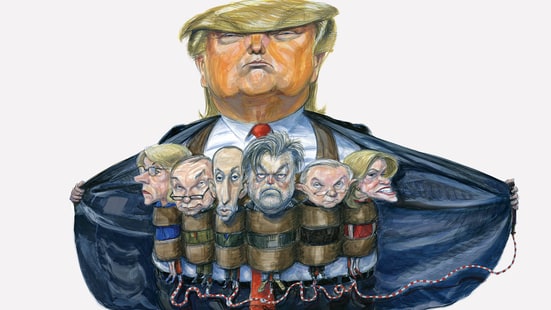
Taibbi on Trump the Destroyer

Trump has stuffed his Cabinet with tyrants, zealots and imbeciles – all bent on demolishing our government from within

For seemingly the 100th time, social media is exploding. This is it! The big reveal!

Perhaps it will come off just the way people are expecting. Perhaps Flynn will get a deal, walk into the House or the Senate surrounded by a phalanx of lawyers, and unspool the whole sordid conspiracy.

He will explain that Donald Trump, compromised by ancient deals with Russian mobsters, and perhaps even blackmailed by an unspeakable KGB sex tape, made a secret deal. He'll say Trump agreed to downplay the obvious benefits of an armed proxy war in Ukraine with nuclear-armed Russia in exchange for Vladimir Putin's help in stealing the emails of Debbie Wasserman-Schultz and John Podesta.

I personally would be surprised if this turned out to be the narrative, mainly because we haven't seen any real evidence of it. But episodes like the Flynn story have even the most careful reporters paralyzed. What if, tomorrow, it all turns out to be true?

What if reality does turn out to be a massive connect-the-dots image of St. Basil's Cathedral sitting atop the White House? (This was suddenly legitimate British conspiracist Louise Mensch's construction in The New York Times last week.) What if all the Glenn Beck-style far-out charts with the circles and arrows somehow all make sense?

This is one of the tricks that keeps every good conspiracy theory going. Nobody wants to be the one claiming the emperor has no clothes the day His Highness walks out naked. And this Russia thing has spun out of control into just such an exercise of conspiratorial mass hysteria.


4 février 2017

Purge de Poutine au sein des services de sécurité russes

Accusés d’avoir transmis des informations aux services de renseignement américains, deux responsables du FSB ont été placés en détention.

Le quartier général du FSB à la Loubianka, au centre de Moscou, le 30 décembre 2016.

Etrange réunion que celle qui s’est déroulée au début du mois de décembre 2016 dans les locaux du FSB, les services russes de sécurité, héritiers du KGB. Sans crier gare, Sergueï Mikhaïlov, numéro deux du centre de sécurité informationnelle (le département spécialisé de cybersécurité du FSB) a été traîné à l’extérieur, les menottes aux mains et un sac sur la tête.

Cette scène, rapportée le 25 janvier par Tsargrad, un site d’informations ultraconservateur proche du pouvoir, s’est accompagnée d’une autre arrestation, celle de l’adjoint de M. Mikhaïlov, le major Dmitri Dokoutchaïev. Puis, ce fut le tour de Rouslan Stoïanov, employé par le géant russe de la sécurité informatique, Kaspersky Lab. Placés à l’isolement dans la prison de Lefortovo, à Moscou, tous font face à la lourde accusation de haute trahison pour le compte des Etats-Unis.

« Ils sont plus de trois », affirme sans s’avancer davantage Ivan Pavlov, l’avocat de l’un des protagonistes dont il souhaite préserver l’anonymat. Son client actuel encourt, comme les autres accusés, jusqu’à vingt ans de prison. « Il nie les faits », souligne Me Pavlov, en confirmant que le chef d’accusation mentionne la transmission d’informations à « des services de renseignement américains, sans préciser lesquels ». « Mais, très souvent, l’accusation initiale n’est que la partie émergée de l’iceberg », ajoute cet avocat qui a déjà défendu plusieurs personnes, russes et ukrainiennes, soupçonnées, en Russie, de haute trahison.

Publicité
25 novembre 2016

Russians on LinkedIn. Русские на Линкедин.

В связи блокировкой социальной сети LinkedIn на территории РФ, создана данная группа, чтобы облегчить поиск информации, установление контактов между более чем 6,9 млн человек имеющих русскоязычные профили, в том числе, за пределами России.

Целью группы также является продвижение российских продукции и услуг за пределами РФ, в том числе размещение кадровых предложений по следующим отраслям:

горнорудная, финансовая, химия, нефтехимия, электроэнергетика, вся группа специалистов строительного кластера, интермодальные перевозки грузов, специалисты в области управления за пределами РФ, научные работники всех областей промышленности с предоставлением работы за пределами России.

Объединение русскоязычной диаспоры.

Для продвижения профессиональных специалистов и компаний за пределами РФ.

Также будет размещена информация о научных разработках и технологиях, запатентованных авторами, которых являются граждане России.

Продвижение по всем профессиональным отраслевым порталам и сетям.

Доступ и содействие публикациям в зарубежных цитируемых научных периодических изданиях.

Машиностроительный комплекс.

Мастера российского ювелирного искусства.

Очерки профессиональной жизни российских специалистов за пределами РФ

In communication blocking of social network LinkedIn in the territory of the Russian Federation, created this group to facilitate search of information, establishment of contacts between more than 6,9 million people the having Russian-speaking profiles, including, outside Russia.

The group purpose also is promotion Russian products and services outside the Russian Federation, including placement of personnel offers on the following industries: mining, financial, chemistry, petrochemistry, power industry, all group of specialists of a construction cluster, intermodal transports of freights, specialists in the field of management outside the Russian Federation, scientists of all fields of the industry with provision of work outside Russia.

Consolidation of Russian-speaking diaspora.

For promotion of professional specialists and the companies outside the Russian Federation. Also information on the scientific developments and technologies patented by authors whom citizens of Russia are will be placed.

Promotion according to all professional industry portals and networks.

Access and assistance to publications in the foreign quoted scientific periodicals.

Machine-building complex.

Masters of the Russian jewelry art.

Sketches of professional life of the Russian specialists outside the Russian Federation

21 octobre 2016

Why geolocation in central Moscow has become a real headache

Over the past several months, Muscovites have been busy complaining on social media that their GPS-powered mobile apps are malfunctioning. Users of Yandex.Navigator have run into frequent problems, for example, watching their vehicles’ locations bounce all over the map. When the Pokemon Go craze arrived in Russia earlier this year, Moscow’s geolocation issues became truly widespread.

Everyone experiencing problems seems to report one thing in common: devices start going weird near the Kremlin, at the very center of Moscow. Earlier this week, the popular blogger and podcaster Grigory Bakunov, better known online as “Bobuk,” investigated these troubles firsthand.

Bakunov says he got so fed up with all the speculation about what is happening with geolocation near the Kremlin that he loaded a backpack full of devices that use GPS and GLONASS, hopped on a segway, and set off to do laps around central Moscow, measuring the strength and accuracy of his geolocation signals.

He spent three hours rolling around the Kremlin, starting at 9 a.m. and wrapping up at noon. “Cutting across the city on a segway for three hours in 2-degree weather was quite the rush,” Bakunov recalled.

The reason this stunt was more than just another vague complaint about malfunctioning geolocation is that Bakunov mapped his entire experiment. He was able to measure, in blue and red, where his GPS and GLONASS devices succumbed to location-spoofing. Take a look at his map, and you’ll see that the epicenter of the geolocation interference is somewhere inside the Kremlin.

Geolocation spoofing around the Kremlin.
Geolocation spoofing around the Kremlin. Grigory Vakunov / Telegram

Bakunov says he believes there is a powerful transmitter operating at random times inside the Kremlin, spoofing geolocation signals on the L1 frequency, which is what civilian devices rely on for geolocation. (According to Bakunov, the transmitter is also jamming the L2 and L5 frequencies, which militaries use for increased accuracy and reliability.)

When Bakunov's devices came under the influence of the spoofing transmission, they suddenly thought they were at the center of Vnukovo airport, roughly 30 kilometers southwest of the Kremlin.

Bakunov speculates that this is because the government is targeting drone quadcopters, many of which now come preprogrammed to stop operating near major airports.

It’s also possible, he says, that Russian officials simply wanted to spoof another location in Moscow besides the city center, in order to deflect the drones, and Vnukovo is alphabetically the first airport in Moscow that appears in most drones’ no-fly lists.

In 2013, the world’s bestselling drone-maker, Chinese technology company DJI, introduced geo-fencing, a technology that uses geolocation signals to stop its machines from flying too close to airports and other restricted areas. Vnukovo International Airport is on the list. If a geo-fence-enabled DJI drone suddenly thought it was approaching Vnukovo, it would either land immediately and refuse to take off again, or pause at the geo-fence boundary and not enter the airport’s airspace.

The Kremlin’s geolocation interference had a slightly less dramatic effect on Bakunov, a 39-year-old man wearing a backpack and riding a segway. He didn’t test any drones, unfortunately.

“If you’ve got an Android device, turn off the GPS,” Bakunov advised his readers. “If you’re on iOS, deal with it.”

18 octobre 2016

Toil and Trouble: Labor Protests in Russia

Last week, coal miners in the town of Luchegorsk began a hunger strike. Taken by itself, the news isn’t all that notable: the town is both tiny and in the middle of nowhere (sorry, Luchegorsk…). But the strike is important in that it fits into a larger trend, and one potentially of concern to local authorities: Russia has seen a spike in labor-related protests as a result of ongoing economic difficulties (workers face wage cuts, delayed payment, or cuts to their work hours) – a recent report by the Center for Economic and Political reform (Russian) highlights these trends and provides useful data. A couple of specific cases have received coverage in the West (see protests by long haul truckers a year ago); most have not. So while the number of labor protests has increased (see graph 1 below), and may have begun to increase from 2015 levels as of recently (see graph 2), the key question is what does all of this mean

15 juillet 2016

« Nous sommes Européens »

Alexander Sneguirev, écrivain russe

« J’ai appris le français à partir de l’âge de sept ans. Ça s’est fait comme ça.

Il y avait quatre écoles spécialisées à côté de notre maison : en anglais, en mathématiques, en sport et en français.

À l’école anglaise, ils ne m’ont pas pris, en sport encore moins, en mathématiques, mes parents n’ont même pas essayé – il restait la française.

La première fois que je suis allé à Paris, je me suis baladé sans plan – j’avais tout appris dans le manuel.

Parmi mes premiers enseignants, il y avait des Africains et des Arabes francophones. J’en ai gardé un petit accent du sud.

Mon grand-père a reçu l’Étoile rouge pour avoir été dans la Résistance française. À l’époque, il était prisonnier. Désœuvré, au camp, il s’associait à toutes les actions : il s’est avéré que c’était ça, la Résistance française.

La France est le premier pays européen qui a commencé à prendre mes livres au sérieux.

La France, c’est une culture, avant d’être une race.

Comme la Russie.

Comme tous les empires

La civilisation repose sur des idées, pas sur des baïonnettes. Tous ceux qui professent les idées de la Grande France sont Français.

Tous sont Européens.

Et nous aussi – nous avons beau regimber -, nous sommes Européens.

Peu importe les rapports que nous avons entre nous : pour nos ennemis, nous ne faisons qu’un. Ce qui veut dire que nous devons être ensemble. Et donc, aujourd’hui, nous pleurons. »

10 juin 2016

Prima Ballerina 1 - Svetlana Zakharova

Svetlana Iourievna Zakharova (Светлана Юрьевна Захарова), née le 10 juin 1979 à Loutsk en Ukraine, est une ballerine russe. Elle est Prima Ballerina du Ballet du Bolchoï et de la Scala de Milan.

Svetlana Zakharova - Princess Aurora

,


Publicité
1 2 3 4 5 6 7 8 9 10 20 30 40 50 60 > >>
marussie
Publicité
Publicité